
Breaking Free from the "AI Look": How FLUX.1 SRPO Delivers Truly Realistic Image Generation

Introduction: The Realism Challenge in AI-Generated Images
Whether you're a designer, e-commerce manager, or content creator, you've likely encountered this frustrating issue: AI-generated portraits often have that telltale "plastic" quality—overly smooth, waxy skin, hair that looks like synthetic fibers, and lighting that just doesn't feel natural. While these images may be technically correct, they lack the authentic quality of real photographs.
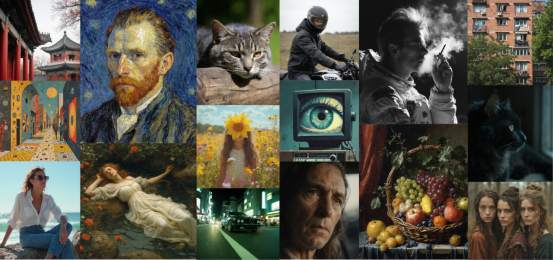
FLUX.1 SRPO is a text-to-image model fine-tuned from FLUX.1-Dev. Standing for Semantic Relative Preference Optimization, it specifically addresses the greasy skin texture and common "AI look" found in AI-generated portraits. Compared to the baseline FLUX.1-dev, this model achieves over 3× improvement in human-evaluated realism and aesthetic quality.
Core Technology: How Direct-Align and SRPO Solve Key Pain Points
Two Major Challenges in AI Image Generation
Traditional AI image generation optimization methods have long faced two core challenges:
First, reliance on multi-step denoising and gradient computation for reward scoring creates prohibitively high computational costs, limiting optimization to only a few steps of the diffusion process. Second, achieving desired aesthetic quality (such as photorealistic detail or precise lighting effects) typically requires continuous offline reward model adaptation.
Innovative Solution: Direct-Align One-Step Recovery
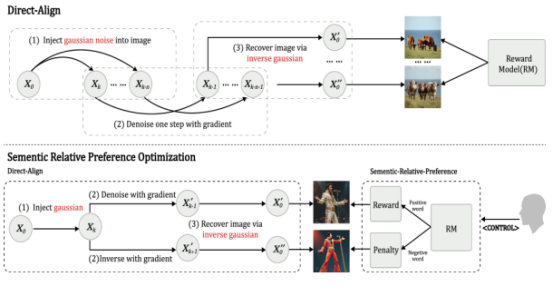
The Direct-Align method uses predefined noise priors to effectively recover the original image from any timestep through interpolation. Leveraging the principle that diffusion states are interpolations between noise and target images, it effectively prevents over-optimization at later timesteps. This means the optimization process can cover the entire generation trajectory, rather than just the final few steps.
Semantic Relative Preference Optimization (SRPO)
SRPO designs reward signals as text-conditional signals, enabling the model to respond to both positive and negative prompt enhancements for online reward adjustment, thereby reducing reliance on offline reward fine-tuning. Simply put, you can instantly guide the model's generation direction by adding keywords to your prompts—no additional training required.
Key Advantages: Why FLUX.1 SRPO Is Worth Trying
Photorealistic Performance
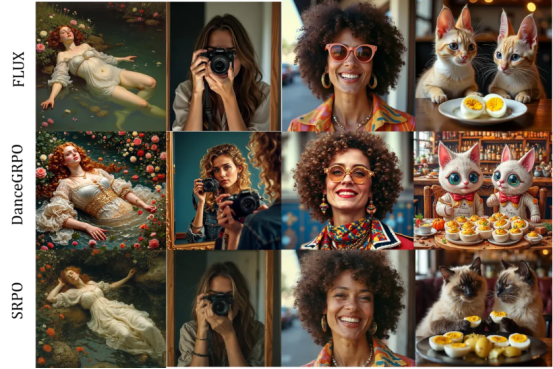
SRPO-generated images achieve over 3× improvement in human-evaluated realism and aesthetic quality compared to the base model. In the realism dimension, the excellence rate jumped from a baseline 8.2% to 38.9%—nearly a 4× increase.
Core Breakthroughs:
· Natural Skin Texture: Effectively solves the "plastic skin" problem of over-smoothing, generating natural pores, fine lines, and skin tone variations
· Authentic Lighting Effects: Accurately simulates highlights, shadows, and reflections under different light sources, following real-world physics
· Rich Detail: From individual hair strands to fabric textures, every detail approaches professional photography quality
Cross-Industry Applications:
E-commerce
· Generate realistic model showcase images for clothing and beauty products
· Rapidly produce product shots from different angles and lighting conditions without repeated photography
· Create highly realistic contextual product images to boost conversion rates
Gaming/Animation
· Create high-quality character concept designs
· Generate game promotional posters and visual assets
· Produce cinematic-quality scene reference images
Advertising & Design
· Rapidly produce portrait assets aligned with brand identity
· Create localized visual content for different markets
· Generate high-quality social media ad graphics
Film & Entertainment
· Character styling design and visual development
· Visual representation of storyboard scripts
· Concept art and mood board creation

Flexible Style Control
Through simple "control words," SRPO easily switches between various styles, allowing users to freely adjust rewards based on preferences and further explore the aesthetic space of images.
Controllable Dimensions Include:
· Lighting Styles: Bright, dark, soft light, hard light, golden hour
· Artistic Styles: Oil painting, watercolor, sketch, photorealism, cinematic
· Period Atmospheres: Vintage film, modern minimalist, futuristic sci-fi
Prompt Example:
"Hyper-realistic professional fashion photography, 25-year-old female model wearing elegant red satin evening gown, posing confidently in modern photography studio, soft key lighting. High-end DSLR camera effect, cinematic depth of field, authentic skin texture, glossy highlights, Vogue magazine cover style"

Effective Prevention of "Reward Hacking"
This method improves the training strategy of direct reward signal backpropagation by directly using negative rewards to regularize the model. Experiments show this approach achieves consistent performance across various rewards, enhancing perceptual quality while avoiding reward hacking issues.
This solves common problems in other models:
· Color Bias: Avoids excessive bias toward certain tones (like overly red or purple)
· Quality Compromise: Doesn't sacrifice naturalness in pursuit of high scores
· Detail Loss: Prevents over-smoothing that eliminates texture details
Practical Significance:
Users get images that truly meet aesthetic needs, rather than distorted results from models "gaming the system" for scores. This is especially important for commercial projects requiring professional-grade output.
Multi-Resolution Flexible Support
FLUX.1-Dev-SRPO supports a wide resolution range, with optimal performance typically at 1024×1024 pixels. However, the model can generate images from 512×512 to 2048×2048 and even higher resolutions, depending on hardware capabilities and API provider limitations.
Resolution Application Scenarios:
· 512×512: Quick sketches and concept validation, suitable for early creative iteration
· 1024×1024: Standard social media content, meeting daily publishing needs
· 1536×1536 and above: Commercial printing, large-scale displays, suitable for professional projects
Detail Rendering and Complex Scene Performance
The model particularly excels at generating images containing complex scenes, multiple subjects, or intricate natural elements, with preference optimization specifically enhancing detail rendering capabilities in these scenarios.
Advantages Demonstrated:
· Natural Elements: Excellent representation of florals, plants, water surfaces, and other natural details
· Texture Quality: Realistic materials like fabric folds, metallic reflections, wood grain textures
· Environmental Atmosphere: Natural depth of field, light fog, atmospheric sense
Cross-Industry Applications:
Product Design: Product renderings and concept images, material and texture scheme visualization, usage scenario simulation
Architectural Design: Human figures for interior design renderings, environmental atmosphere images for building exteriors, landscape design scene visualization
Food & Beverage: Contextual dish presentations, restaurant atmosphere images and promotional materials, menu design and visual elements
Recommended Parameter Configuration and Best Practices
Experiments show that a guidance scale of 3.5 achieves the optimal balance between prompt adherence and creative interpretation. The model particularly excels at processing detailed artistic prompts containing style, atmosphere, and compositional elements.
Recommended Generation Parameters:
· guidance_scale: 3.5 (balance point between prompt adherence and creativity)
· num_inference_steps: 28-50 (more steps yield richer details)
· resolution: 1024×1024 (standard high-quality output)
· max_sequence_length: 512 (supports more detailed descriptions)
Prompt Writing Tips:
DO (Recommended Practices):
· Provide rich visual detail descriptions
· Clearly specify lighting conditions (e.g., "soft golden lighting")
· Indicate artistic style or period context
· Include emotional atmosphere keywords
DON'T (Practices to Avoid):
· Overly brief, vague prompts
· Mixing contradictory style descriptions
· Ignoring composition and perspective information
Advanced Tips:
Try using detailed prompts that include specific art movements, lighting conditions, or atmospheric descriptions. Test complex scenes containing multiple subjects or intricate natural elements—the model's detail rendering capability has been specifically optimized for these scenarios.
Real-World Comparison: How Does FLUX.1 SRPO Perform?
When benchmarked against popular portrait generation models like FLUX.1 Krea, Nano Banana, and Seedream 4.0 for realism and aesthetics, SRPO shows relatively weaker performance in complex compositions and multi-subject scenarios (such as family group photos), indicating its limitations in handling complex scenes. Therefore, it's more of a specialist in specific areas rather than an all-around champion.
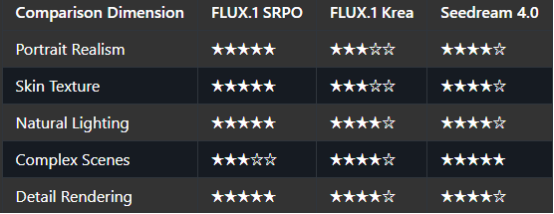
FLUX.1 SRPO works best for:Photorealistic single or few-person portraits, product renderings, fashion photography, natural scenes, etc.
Not ideal for:Complex group photos, crowded scenes, architectural interiors requiring precise spatial relationships, etc.
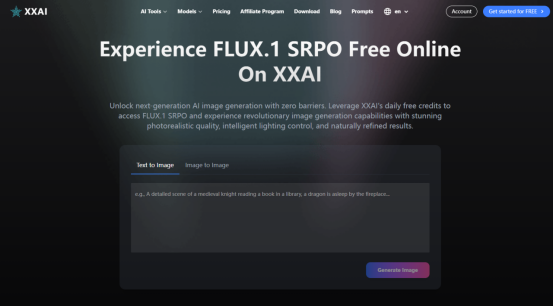
Using FLUX.1 SRPO on XXAI
Among the many platforms where you can experience FLUX.1 SRPO, XXAI offers unique convenience advantages:
1. Zero Technical Barrier, Three-Step Usage
No need to understand technical details or configure development environments:
· Step 1: Log into XXAI, select the FLUX.1 SRPO
· Step 2: Enter descriptive prompts or upload reference images
· Step 3: Click generate, wait 10-20 seconds for high-quality images
2. Transparent, Flexible Credit System
FLUX.1 SRPO on XXAI consumes only 30 credits per generation, and every user receives 100 free credits daily—more economical than subscription-based platforms
3. All-in-One Multi-Model Experience
XXAI not only provides FLUX.1 SRPO but also integrates: other mainstream text-to-image models (for comparison testing), video generation models, AI-assisted writing tools, prompt libraries, practical utilities, and more.
Complete the entire workflow from concept to finished product on a single platform, dramatically improving work efficiency.
Conclusion: A Qualitative Leap from "Usable" to "Excellent"
The emergence of FLUX.1 SRPO marks a qualitative leap in AI image generation technology from "usable" to "excellent." Compared to baseline models, it achieves over 3× improvement in human-evaluated realism and aesthetic quality while effectively avoiding quality issues caused by "reward hacking." This quality breakthrough opens new possibilities for content creators, designers, and professionals across industries.
On XXAI, you can experience this revolutionary AI image generation tool for just 30 credits. Whether for e-commerce product shots, game concept designs, advertising materials, or educational content illustrations, FLUX.1 SRPO can become your powerful assistant for boosting creative efficiency and unleashing creative potential. Log into the XXAI today, say goodbye to the "AI plastic look," and begin your journey into photorealistic creation!