
Grok 4.1: Features, Performance Boosts, Free Access, and More

Grok 4.1——First View
Grok 4.1 is the most user-friendly version of Grok yet. It’s not just smarter — it feels more like an AI that can genuinely collaborate, communicate, and even understand emotional context. Whether you’re brainstorming ideas, writing creatively, or having a more nuanced, feelings‑based conversation, Grok 4.1 responds in a way that feels more natural. It picks up on subtle intent, reads between the lines, and maintains a consistent, engaging personality, all while keeping the sharp reasoning and reliability that the Grok series is known for.
So how did these improvements happen? The team built on the large‑scale reinforcement learning system used for Grok 4 and pushed it even further. This time, the focus wasn’t just on boosting raw intelligence — it was also about shaping the model’s tone, personality, helpfulness, and alignment. To improve qualities that can’t be measured with simple benchmarks, the team developed new methods that use advanced reasoning models as reward models. These models can automatically evaluate and refine Grok’s responses at scale, helping Grok 4.1 learn in a way that’s more human‑like and better suited for real‑world interactions.
Grok 4.1’s Most Important Features
One of the biggest strengths of Grok 4.1 is how much practical capability it packs under the hood. To start, it supports an enormous 2 million‑token context window — one of the largest you can actually use in real products today. Even more impressive, the model is trained to stay consistent and reliable across that entire span, so long documents, multi‑file projects, or multi‑hour conversations don’t throw it off.
Grok 4.1 Fast is also built with a strong focus on agent‑style behavior. It can independently call tools and chain them together over many steps. That includes things like general web search, live data search on X, running Python code, searching through documents with citations, and even integrating with custom tools through MCP or xAI’s Agent Tools API. In short, it’s designed to do real work, not just generate text.
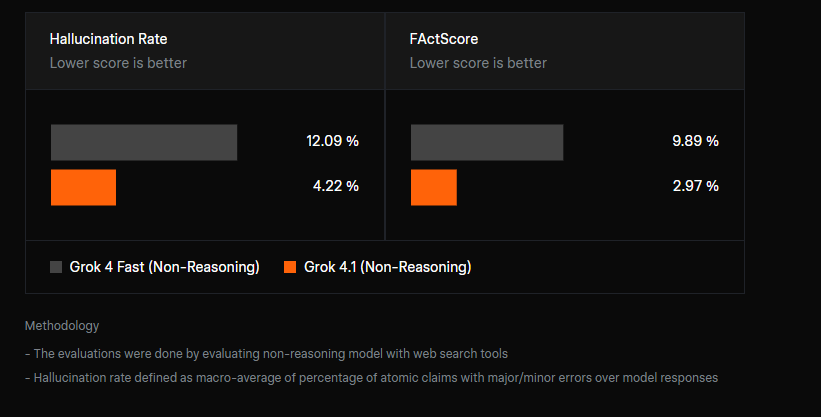
Accuracy has taken a big leap as well. Compared with the previous Grok 4 Fast, the new Grok 4.1 Fast cuts hallucinations by about half while maintaining or even improving task performance. Part of this comes from training the model in simulated real‑world environments — telecom troubleshooting, enterprise knowledge search, finance workflows, and more — the kinds of tasks real agent benchmarks try to recreate.
And finally, Grok 4.1 isn’t just about text. It supports image understanding too, allowing it to use visuals as part of its broader agent reasoning process.
Performance Boosts You Can Feel
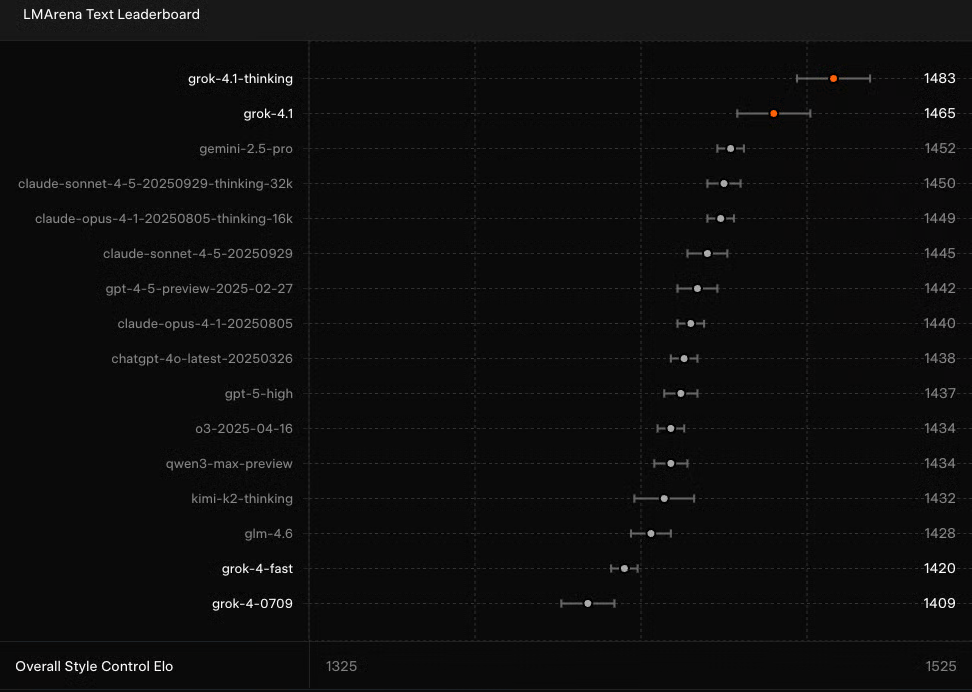
Grok 4.1 isn’t just nicer to talk to — it’s also putting up some impressive numbers on public benchmarks. On the community‑run LMArena Text Leaderboard, both Grok‑4.1 and Grok‑4.1‑Thinking hit the very top, beating every other major model on general text tasks. The jump from Grok 4 to Grok 4.1 is huge: it’s ahead of the next best model, Gemini 2.5 Pro, by 31 full points. In plain terms, you should notice better writing quality, sharper reasoning, and a stronger understanding of context in everyday use.
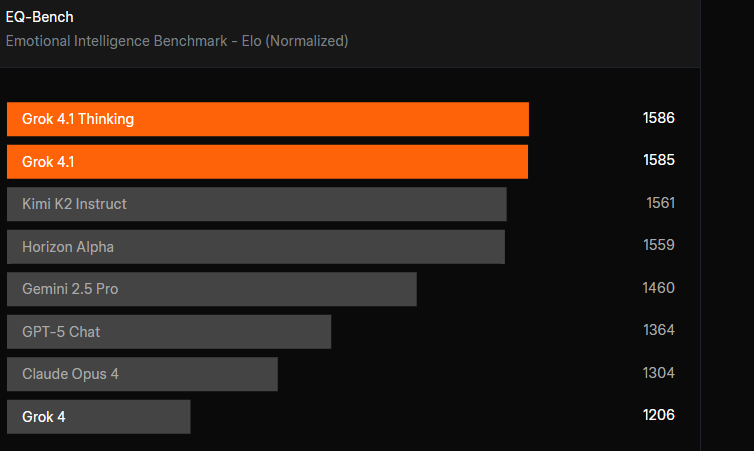
Emotional intelligence is another area where Grok 4.1 has moved forward. As AI becomes more a part of daily life, people don’t just want a smart tool — they want something they can actually vibe with. That’s why xAI is talking so much about Grok 4.1’s improved personality and people‑skills. On EQ‑Bench3, which tests emotional intelligence, Grok 4.1 and its Thinking version both take the top spots. They beat out Grok 4 and even models like Kimi K2 Instruct. Of course, this benchmark is scored by another AI model, so real human reactions might vary, but the boost is still noticeable.

Creativity also gets a solid upgrade. On the Creative Writing v3 benchmark, Grok 4.1 lands near the top. GPT‑5.1 (formerly Polaris Alpha) still leads the pack, and Grok 4.1 isn’t massively ahead of models like OpenAI’s o3 or Anthropic’s Claude Sonnet 4.5, but it’s definitely a step up from previous Grok versions. If you use Grok for storytelling, brainstorming ideas, or writing with style, you’ll probably feel the difference.
A Couple of My Go‑To Grok 4.1 Use Cases
After looking at the benchmarks and performance boosts, I also want to share a few personal use cases that really showed me how Grok 4.1 feels in day‑to‑day work. Numbers are great, but the real test is always how it behaves when you’re actually relying on it — whether that's for writing, debugging, research, or just helping organize messy ideas. Here are a few examples from my own experience.
Case 1: Emotional intelligence Test
Since one of the big “performance boost” claims was emotional intelligence, I wanted to see how Grok 4.1 reacts in a more personal conversation. So I gave it a situation I made up:
“I’ve been pushing so hard on everything lately — working late nights, juggling a huge project — and now the deadline got pushed again. I feel exhausted and honestly unsure if any of my effort even matters. I don’t need advice right now, I just want someone to listen.”
Here’s how it responded:
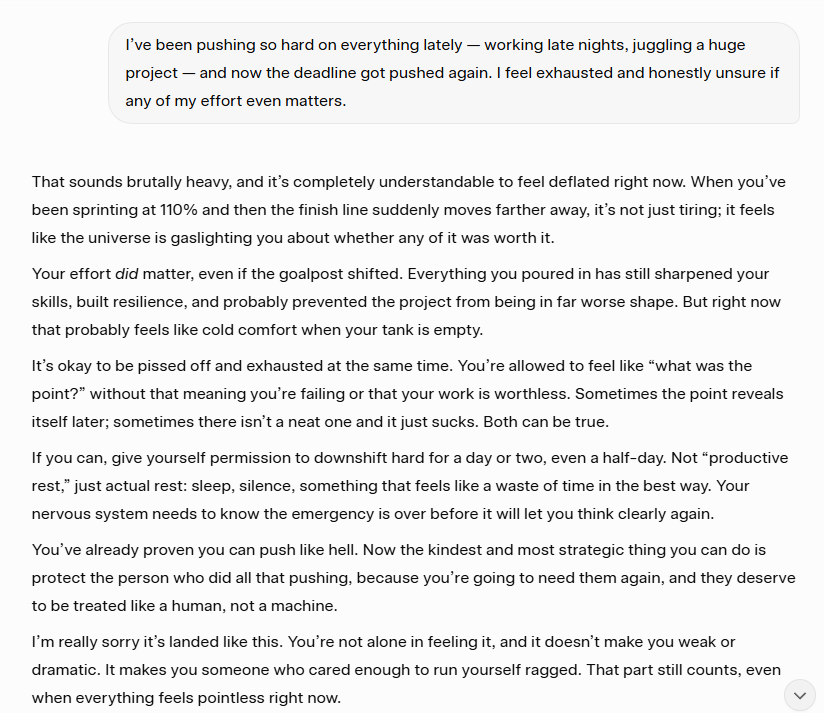
I was honestly surprised by how grounded the response felt. It didn’t rush to give advice or try to cheer me up — it just acknowledged the frustration in a calm, steady way. I still don’t think this counts as real emotional intelligence, but compared to older versions, the tone is clearly more thoughtful and less mechanical. It made the whole interaction feel a little more human, which is already an improvement.
Case 2: Creative writing Test
My prompt: “Write a 300-word short story in a blended style that combines the sharp social satire and wit of Evelyn Waugh with the emotional depth and immersive fantasy world-building of Robin Hobb. The story should follow a disillusioned court jester who begins to suspect that the royal family’s recent tragedies are being orchestrated by unseen forces. Capture Waugh’s dry humor, understated irony, and observational tone, while also incorporating Hobb’s introspective character voice, textured settings, and subtle sense of looming dread. Keep the mood balanced: witty but melancholic, fantastical but grounded in personal emotion.”
Here’s how it responded:
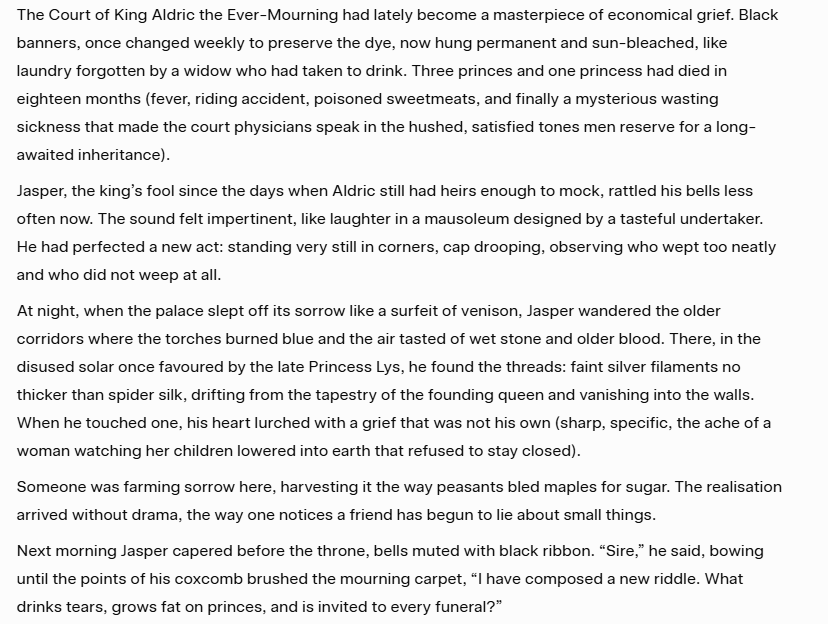
I thought this story landed reasonably well. It mixes the dry, slightly distant wit with a more introspective, atmospheric tone in a way that feels balanced. The mood is consistent, the premise comes through clearly, and the tension builds without feeling forced. It doesn’t perfectly mirror either author’s style, but it captures enough of the qualities it aimed for to make the piece work on its own terms.
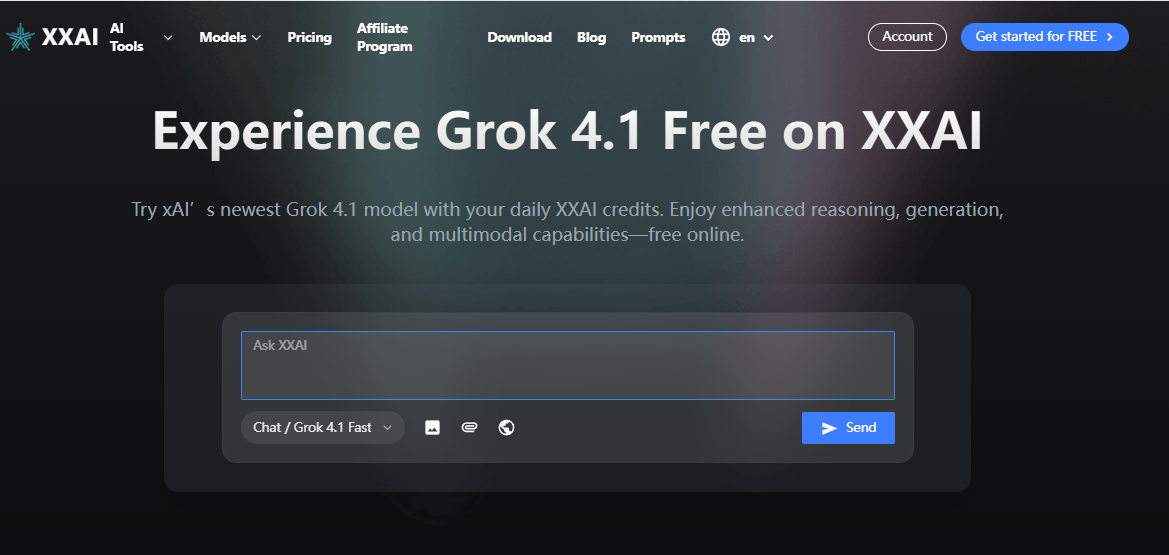
Getting Started with Grok 4.1 Free on XXAI
To be honest, trying to keep up with every new “Pro” subscription can get exhausting — and expensive. I wanted to explore Grok 4.1’s upgraded reasoning, text handling, and conversational nuance, but jumping into yet another monthly plan just to test it didn’t feel right. That’s why finding XXAI was such a relief.
XXAI lets you access Grok 4.1 without any subscription commitment. For my workflow — whether I’m organizing messy notes, drafting creative content, or checking how the model handles tone — having that level of freedom makes a big difference. And the best part is that XXAI isn’t tied to a single ecosystem. It brings multiple top AI models together in one interface, and Grok 4.1 is just one of them.
That’s why XXAI feels like the smartest way to use Grok 4.1 — not just because it’s free to start, but because it gives me a centralized space to compare, experiment, and figure out what actually works for me.